Google's 2026 AI Search Overhaul Explained
Google Search Overhaul, AI-driven Search, Generative AI
Inside Google’s 2026 Search Overhaul: What Agentic, AI-Driven Search Means for Professionals
Google’s latest Google Search Overhaul is more than a product update; it is a structural reset of how information is found, synthesized, and acted on. For professionals who rely on search, including marketers, strategists, product leaders, and publishers, understanding this shift to an AI-driven Search and “agentic” experience is now a core part of staying competitive.
The Reimagined Intelligent Search Box: From Keywords to Conversations
Google calls this the biggest upgrade to the Search box in more than 25 years, and that is not hyperbole. At the center of the Google Search Overhaul is a completely reimagined Intelligent Search Box, powered by the Gemini 3.5 Flash model. Instead of being a narrow field for short keyword strings, it has become a flexible, multimodal canvas for complex, real-world questions and tasks.
Multimodal inputs: One box, every signal
The new box accepts text, images, files, video, and even open Chrome tabs in a single query (Google I/O 2026). This multimodal capability means professionals can:
Upload a PDF report, paste a URL, and attach a screenshot, then ask for a synthesized executive summary.
Point a phone camera at a competitor’s product, add a short text prompt, and get a breakdown of specs, reviews, and market positioning.
For knowledge workers, this collapses multiple steps, such as searching, opening tabs, and cross-checking sources, into a single, blended interaction. It is classic search, but with the friction largely removed.
Query fan-out: Search that thinks in parallel
Under the hood, the box now uses a query fan-out system. Instead of treating your input as a single question, Google splinters it into multiple subqueries and runs them in parallel across the web, your personal context, and structured data sources. Gemini 3.5 Flash then stitches those threads back together into an AI Overview, a synthesized response that aims to answer the question you meant to ask, not just the one you typed.
This fan-out approach is particularly powerful for professionals researching markets, regulations, or technical topics. Instead of bouncing between ten tabs, you get a layered answer that already accounts for definitions, comparisons, and emerging trends, often supported by “Expert Advice” panels summarizing discussions from Reddit and other public forums (TechRadar).
Seamless conversational continuity: Search as an ongoing dialogue
The new experience does not end with a single answer. Google’s AI Mode, already used by over a billion people monthly, turns search into a persistent conversation. You can ask follow-up questions, refine criteria, or pivot completely, and the system keeps track of context across turns (Google I/O 2026).
For busy professionals, this conversational continuity is where the value compounds. Instead of repeatedly rephrasing queries (“now compare this to Europe,” “what if my budget is smaller?”), you can interact with the Intelligent Search Box almost like a colleague who remembers the entire thread of your project.
💡 Pro Tip: Treat AI Mode like a research partner. Start broad, then narrow with follow-ups; each turn refines Gemini’s understanding of your professional context and goals.
From Search to Agentic Search: Autonomous Information Agents and Generative UI
The most transformative part of the Google Search Overhaul is the move from reactive search to Agentic Search. Instead of waiting for you to ask, Google is building Autonomous Information Agents that monitor, interpret, and act on information on your behalf.
Autonomous Information Agents: Always-on research assistants
Google’s new agents can watch the web 24/7 for topics you care about, such as industry regulations, competitor moves, and product reviews, and proactively notify you when something meaningful changes (Google Search I/O 2026). This is Agentic Search in action: the system does not just retrieve; it continually interprets and escalates.
A communications lead might have an agent track sentiment around a brand across forums, news, and social platforms, surfacing only notable shifts.
A product manager could ask an agent to monitor competitor feature launches and summarize what matters for their roadmap each week.
These Autonomous Information Agents are initially rolling out to Google AI Pro and Ultra subscribers, reflecting a “subscription-first” model for advanced capabilities (TechCrunch). Over time, they are likely to become standard tools in the professional toolkit, much like alerts and dashboards are today.
Generative UI and super apps: Mini-apps inside Search
Layered on top of these agents is Google’s “Antigravity” platform, which uses Generative AI to create dynamic, stateful mini-apps directly within Search. With a natural-language prompt, you can effectively spin up a lightweight “super app” tailored to a specific workflow:
A campaign planning board that tracks channels, budgets, and performance, all living inside Search and powered by live data.
A competitive intelligence dashboard that updates as your information agent discovers new data points.
Instead of bouncing between SaaS tools, browser tabs, and spreadsheets, these generative UIs pull everything into one, adaptive interface. Search becomes an operating layer for work, not just a starting point.
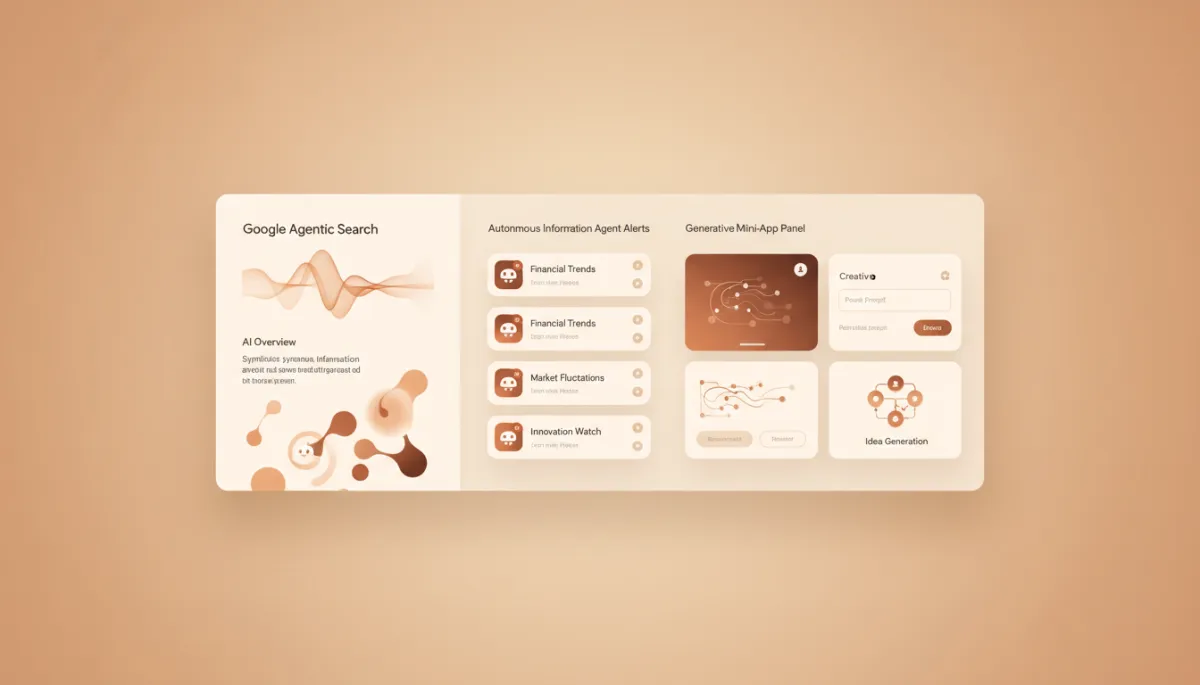
Agentic Search turns Google into a proactive workspace, not just a list of links.
The Open Web Under Pressure: Zero-Click Searches and the New Reality for Creators
For all its user benefits, the Google Search Overhaul raises urgent questions about the future of the open web. As AI Overviews and conversational answers become the default, more searches end without a click. Zero-click searches, already a concern in the pre-AI era, are accelerating as Google shifts from “10 blue links” to synthesized, AI-first responses.
From blue links to synthesized answers
Recent data suggests that position-one click-through rates have fallen from around 27 percent to as low as 11 percent, while AI Overviews now appear in nearly half of all searches (Advisable). In other words, Google is increasingly answering the question itself, rather than sending the user to the sites that provided the underlying information.
For web creators and marketers, this is a profound shift. Visibility still matters, but the value of a rank position is now mediated by how often your content is surfaced inside AI Overviews, “Expert Advice” panels, and conversational responses, often without a click or a pageview attached.
Implications for web creators, brands, and marketers
In this AI-driven Search landscape, the rules of engagement are changing:
Authority and trust beat raw traffic. Google’s May 2026 Core Update and AI-first interface both reward depth, expertise, and originality. Thin, keyword-stuffed content has little chance of being surfaced or cited by Generative AI models.
Brand becomes a ranking factor in practice. When a synthesized answer draws on multiple sources, recognizable and trusted brands are more likely to be cited, linked, or highlighted in “Expert Advice” sections. Building brand equity is now an SEO strategy, not just a marketing one.
On-site experiences must justify the click. If Google can answer basic questions, users will only click through for richer experiences, including tools, calculators, interactive content, proprietary data, and strong points of view. Static copy is no longer enough.
📌 Key Takeaway: In a world of rising Zero-click Searches, measure success beyond raw traffic; look at brand mentions in AI answers, direct visits, email growth, and conversions from high-intent audiences.
How Professionals Should Respond to the Google Search Overhaul
Whether you run a brand, manage content, or advise clients, the question is no longer “Will this change search?” It already has. The question is how to adapt to an Agentic Search world while still serving your audience and hitting business goals.
Design for AI as much as for humans
Content now has two primary audiences: human readers and AI summarizers. That means:
Clear structure, headings, and concise explanations that are easy for models to parse and quote.
Strong, evidence-backed statements that can stand alone when pulled into an AI Overview.
Distinctive perspectives that differentiate your insights from generic web content.
Rethink measurement and strategy
As Zero-click Searches grow, traditional SEO metrics will tell only part of the story. Professionals should:
Track branded search volume, direct traffic, and engagement as proxies for visibility in AI-driven experiences.
Invest in owned channels, including email, communities, and apps, where you control the relationship, not just the referral.
Experiment with how your content appears in AI Overviews by testing query patterns and monitoring which assets are cited.
The Bottom Line: Search Is Becoming a Partner, Not a Page of Results
With this Google Search Overhaul, Search is evolving from a passive index into an active Agentic Search companion, driven by Generative AI, powered by Autonomous Information Agents, and surfaced through an Intelligent Search Box that understands context, media, and intent.
For professionals, the opportunity is twofold. As users, you gain tools that compress hours of research into minutes and turn Google into a living workspace. As creators and marketers, you face a more competitive, more filtered environment where quality, authority, and distinctiveness are nonnegotiable. The open web is not disappearing, but the pathways through which people reach it are being radically rewritten.
Those who adapt their strategies, designing for AI as well as humans, investing in brand and depth, and embracing new measurement models, will find that this new era of AI-driven Search can be an advantage rather than a threat. Search is no longer just where the journey starts; increasingly, it is where work gets done.


